

Image Source: Key Bridge Rebuild
A $5.2 billion bridge is being built in Baltimore. It’s Maryland’s first cable-stayed highway bridge, designed with 230 feet of vertical clearance and four lanes of traffic. Construction runs through 2030. And it requires thousands of skilled workers.
The Francis Scott Key Bridge collapsed on March 26, 2024, when a cargo ship lost electrical power and collided with a support pier. The maintenance crew filling potholes on the center span during the collision tragically lost their lives. What follows is a rebuild effort of serious scale and complexity. As Baltimore County has planned reconstruction, there have been issues with design, contractors, and cost. What is clear is they need trained diesel mechanics and skilled trades workers to handle the job.
The Key Bridge Crisis
When the bridge fell, Baltimore County and the Maryland Department of Labor knew reconstruction would require massive equipment such as heavy cranes, excavators, dozers, and dump trucks. Which would all need qualified operators and mechanics. The county secured funding to support recovery and rebuilding efforts and are offering grants for trade school students.
Neishall Schuyler On Grants From the Department of Labor
“We were granted funds from the Maryland Department of Labor for a grant to help support the recovery and rebuilding of the bridge,” explains Schuyler, Senior Manager for Strategic Workforce Initiatives for Baltimore County’s Department of Economic and Workforce Development. “We found out that we don’t have enough diesel mechanics for all the heavy equipment that’s going to be used to help build that bridge. So we wanted to reach out and find an education partner that could help get our residents ready for those roles when they become available.”
The education partnership between Baltimore County and North American Trade Schools connects residents with training that aligns directly to jobs that will exist throughout the rebuild.
The Real Opportunity
“College may not be for everyone,” Schuyler says. “There are those people that like the trades and we need that skill set. I want people to understand that college may not be for everyone, and there are other options for you to take care of yourself and your family.”
Skilled trades workers are in demand, wages are competitive, and the work is meaningful. The Key Bridge rebuild didn’t create this need. It simply added some urgency in Baltimore. For diesel technicians, the work exists. They will need qualified people as the project moves along.
What’s Happening on the Key Bridge
So, what does a bridge rebuild look like? Here’s what’s underway as of mid-2026:
The New Bridge Design
The Francis Scott Key Bridge will be reborn as Maryland’s first highway cable-stayed bridge. It’s a modern engineering approach that’s more economical and faster to construct than traditional designs. The specifications tell the story of what skilled workers will need to handle:
- Two lanes in each direction (four total lanes, matching the original capacity)
- 230-foot minimum vertical clearance to accommodate larger commercial vessels
- Four shoulders: 10-foot exterior shoulders and 4-foot interior shoulders in each direction, separated by a concrete median
- A main span that’s been increased for additional shipping channel clearance, preventing future vessel strikes
This isn’t a simple repair. This is a $5.2 billion, complex infrastructure project designed for safety and longevity.
The Construction Timeline
- Pre-construction: Began January 2025
- Production pile installation: Starting late 2025
- Test pile driving: Already underway (began October 2025, continuing through early winter 2025-26)
- Full construction: Ongoing through 2030
- Opening to traffic: Late 2030 (updated estimate from November 2025)
This means skilled workers will be needed for the next 4+ years.
The Workforce
The project team is driving 8-foot diameter, 200+-foot long steel test piles into the Patapsco River to prove foundation concepts. This work requires:
- Equipment operators who understand heavy machinery
- Diesel mechanics to maintain that equipment in harsh waterside conditions
- Specialized technicians who can troubleshoot problems on the fly
- Welders, ironworkers, and heavy equipment operators coordinating complex operations
The MDTA has installed bubble curtains around test piles to manage noise and protect wildlife. But that equipment needs maintenance too. Every component of this operation depends on someone who knows how to keep machines running.
The Demolition Phase (Already Underway)
Starting in summer 2025, crews began removing the remains of the original bridge. This is a process that demonstrated the immediate workforce need:
- Removal of deck, barriers, and parapets from both Hawkins Point and Sollers Point
- Extraction of girders and landside approach structures
- Removal of north and south abutments
This heavy machinery work requires experienced operators and mechanics who can work safely in complex environments.
The Construction Trestle: A Temporary Bridge Within the Bridge
One of the most interesting engineering solutions is the construction trestle. It’s a temporary support structure (essentially a temporary bridge close to the waterline) that will serve as the stable platform for assembly and construction. Building and maintaining this structure requires skilled laborers and equipment operators who understand precision, safety, and structural integrity.
Each of these phases (demolition, trestle construction, pile driving, main span assembly) depends on skilled tradespeople.
Trade Work Opportunity
The project is in early stages. Production and demolition work is ongoing, but the demand for tradespeople will scale significantly as the project moves into the main span construction phase through 2030.
Baltimore County has secured grant funding specifically to support training for this rebuild. Meaning lower or eliminated tuition barriers for qualified residents.
“If that is your position, then you can come to the American Job Center,” Schuyler advises residents. “See what you qualify for and we would be more than happy to walk you through the process and see what we can do to help you reach your educational and employment goals. One of the first places you can start is North American Trade Schools.”
The pathway is clear. The timeline is long. The need is documented.
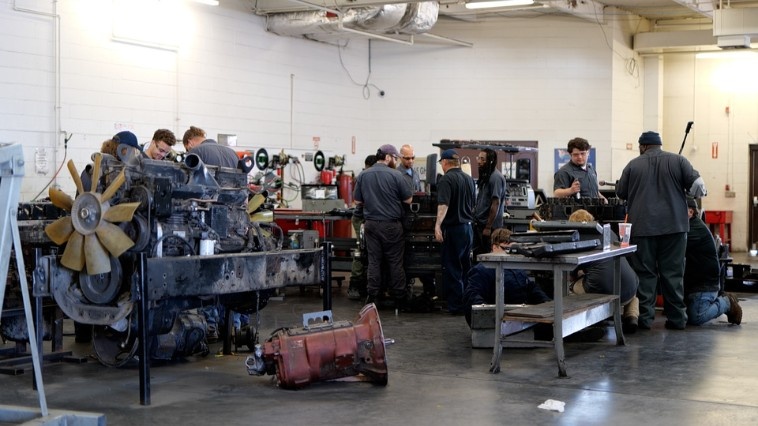
Why Diesel Technology Specifically?
The rebuild requires thousands of pieces of equipment, and every one of them runs on diesel. Here’s why diesel technicians are critical:
- Heavy excavators for riverbed work and pile extraction
- Cranes and dozers for material movement and assembly
- Dump trucks and haulers for debris removal and material delivery
- Barges and marine equipment for water-based demolition and construction
- Generators and power equipment for worksites spanning miles
NATS diesel technology program teaches students:
- Engine diagnostics and repair
- Hydraulic systems
- Electrical systems in heavy equipment
- Equipment maintenance protocols
- Real-world troubleshooting under pressure
Learn More
About the Key Bridge Collapse and Rebuild:
- Key Bridge Collapse: Victims’ families remember the tragedy one year later
- Key Bridge Rebuild Official Website