
The Complete Step-by-Step Guide
Maryland CDL Fast Facts
- The trucking industry supports more than 116,000 jobs in Maryland and pays over $6 billion in wages statewide.
- Nearly 93% of Maryland communities depend exclusively on trucks to receive goods.
- The national median wage for heavy and tractor-trailer truck drivers was $57,440 in May 2024.
- The Port of Baltimore handled 45.9 million tons of cargo in 2024, one of the strongest years in the port’s history.
- The U.S. faces a projected shortfall of 160,000 truck drivers by 2030.
Sources: Maryland Motor Truck Association | U.S. Bureau of Labor Statistics, Occupational Outlook Handbook | Port of Baltimore 2024 tonnage | MDOT
A Commercial Driver’s License is one of the most direct paths to a skilled, well-paying career available without a four-year degree. CDL holders are in demand across a wide range of industries. For many drivers, it also means flexibility: local routes that bring drivers home every night, regional schedules, or long-haul work for those who prefer life on the road.
Maryland is one of the stronger markets in the country for this career. The Port of Baltimore, a major hub for auto transport, bulk cargo, and containerized freight, generates constant demand for qualified drivers. So does the state’s proximity to Washington, D.C. and the dense Mid-Atlantic corridor, which keeps regional freight volume high year-round.
Jump to a Section:
What is a CDL and Who Needs One?
Maryland CDL Requirements
How to Get a CDL in Maryland: Step by Step
CDL Costs in Maryland
After Passing: What Happens Next?
Frequently Asked Questions
What Is a CDL and Who Needs One?
Vehicles requiring a CDL to operate fall in one of three classes:
Choosing which of these licenses to pursue depends on your career goals.
| Class | Vehicle Type | Examples | Also Authorizes | Typical Employers |
|---|---|---|---|---|
| A | Combination vehicles; trailer exceeds 10,000 lbs. GVWR | Tractor-trailers, flatbeds, tankers, livestock carriers | Class B and C vehicles | Long-haul trucking companies Freight carriers Fuel distributors Grocery and food distribution Auto transport Construction material haulers |
| B | Single vehicle 26,001+ lbs.; trailer under 10,000 lbs. GVWR | School buses, city buses, dump trucks, delivery trucks | Class C vehicles | School districts Public transit agencies Waste management companies Construction companies Large retailers and delivery services |
| C | Under 26,001 lbs.; carries 16+ passengers or hazmat requiring placards | Passenger vans, smaller hazmat vehicles | Class C only | Non-emergency medical transport Paratransit services Small hazmat carriers Some utility companies |
Source: Maryland MVA CDL Classes
Earning Potential by Class
Class A drivers typically earn the most because they can operate the widest range of vehicles. Starting wages in Maryland average $55,000 to $65,000 annually, with experienced drivers earning $70,000 or more within three years.
Source: U.S. Bureau of Labor Statistics, Occupational Outlook Handbook
What Are Maryland’s CDL Requirements?
Before applying for a Commercial Learner’s Permit, applicants must meet both federal and Maryland-specific requirements.
| Requirement | Details |
|---|---|
| Minimum age | 21 years old for interstate driving or hazardous materials; 18 for intrastate-only routes within Maryland |
| Valid Maryland license | Must hold a current Maryland driver’s license at the time of application |
| Identity documents | Government-issued photo ID and Social Security number documentation |
| Vision screening | Required at the MVA as part of the CLP application |
| DOT medical exam | Certificate from a National Registry-certified medical examiner; valid for up to 24 months |
| ELDT completion | Required for first-time Class A or Class B applicants before the skills test can be scheduled |
Source: Maryland MVA CDL Requirements | FMCSA Medical Requirements
How to Get a CDL in Maryland: Step by Step
Step 1: Earn the Commercial Learner’s Permit (CLP)
Step 1A: Complete a DOT Medical Exam
A Department of Transportation (DOT) medical exam is required before taking any knowledge test. The exam must be performed by a doctor listed on the National Registry of Certified Medical Examiners. In Maryland, the exam typically costs $85 to $210, with $145 being the most common fee. The certificate is valid for up to 24 months.
Sources: National Registry of Certified Medical Examiners | Baltimore DOT Physical cost range | FMCSA Medical Certification
Step 1B: Study the Maryland CDL Manual
The Maryland CDL Manual covers everything on the knowledge test and is available for free through the Maryland MVA website. The sections to study depend on the class being sought.
| License Class | Sections to Study |
|---|---|
| Class A | General Knowledge, Air Brakes, Combinations |
| Class B | General Knowledge, Air Brakes, Passenger, School Bus (as applicable) |
| Class C | General Knowledge, plus any applicable endorsement sections |
Source: Maryland CDL Manual
Step 1C: Pass the Knowledge Tests and Receive the CLP
The General Knowledge test contains 50 questions. A passing score is 80% or higher. Each endorsement section (Air Brakes, Combinations, Passenger, School Bus) has additional questions at the same 80% threshold. The $90 CLP fee is paid after passing all required tests. Tests can be retaken if needed, but passing everything in one visit saves time.
Sources: Maryland MVA CDL Skills Test | CDL Practice Test question count
Commercial learner’s permits are issued at Maryland Motor Vehicle Administration (MVA) offices throughout Maryland. Appointments can be scheduled through the myMVA online portal or by calling 1-800-950-1682. Pre-applying online speeds up the in-person visit.
Tip: Prepare Before Visiting the MVA
Gather all documents before scheduling an appointment: government-issued photo ID, Social Security documentation, and the DOT medical certificate. Showing up without the required paperwork means rescheduling.
Step 2: Complete Entry-Level Driver Training
Federal law requires Entry-Level Driver Training (ELDT) for anyone receiving a new Commercial Learner’s Permit. ELDT applies to:
- First-time Class A or Class B applicants
- Drivers upgrading from a Class B to a Class A license
- Anyone adding a school bus, passenger, or hazardous materials endorsement for the first time
All training must be completed with a provider registered on the FMCSA Training Provider Registry (TPR). Providers submit completion records directly to the registry, which the Maryland MVA verifies before scheduling the skills test.
What ELDT Covers
ELDT has two required components that cannot be substituted or skipped:
| Component | Content | Format |
|---|---|---|
| Theory Training | Vehicle operation, safe driving procedures, vehicle systems, hours of service regulations | Classroom or online coursework |
| Behind-the-Wheel Training | Pre-trip inspection, basic vehicle control, on-road driving in real traffic conditions | Must be completed in actual vehicles with a certified instructor — no online substitute |
Source: FMCSA ELDT Regulation Details
Step 3: Pass the Maryland CDL Skills Test
Maryland requires a minimum 14-day holding period after a CLP is issued before the skills test can be scheduled. Appointments are booked through the myMVA portal or by calling the MVA directly.
Drivers must bring three items on test day:
- Valid Maryland Commercial Learner’s Permit
- Current Medical Examiner’s Certificate (DOT card)
- A properly registered commercial vehicle that matches the license class being tested
The Three-Part Skills Test
| Test Section | What Is Evaluated | Key Focus Areas |
|---|---|---|
| 1. Pre-Trip Inspection | Driver’s ability to identify vehicle components and explain each safety check aloud | Tires, lights, mirrors, brakes, fluids, suspension, required documentation |
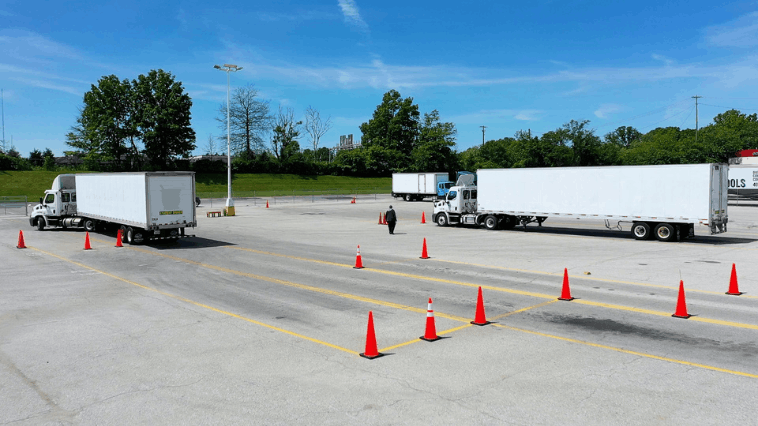
| 2. Basic Controls | Maneuvering ability in a closed, controlled area without live traffic | Straight-line backing, offset backing, vehicle control accuracy |
| 3. Road Test | Driving performance in real traffic conditions | Lane changes, turns, speed management, mirror checks, signaling |
Source: Maryland MVA Skills Test Overview
Most Common Reasons for Skills Test Failure
Incomplete pre-trip inspections are a frequent cause of failure. Other common mistakes include skipping mirror checks, poor speed management, missing turn signals, and misjudging vehicle clearance. Failing any section costs $20 to reschedule that portion.
Get CDL Training at North American Trade Schools — we handle steps 1–3 for you.
No need to get your DOT physical or Commercial Learner’s Permit before the program. We take care of it.
How Long Does CDL Training Take?
ELDT does not set a fixed number of training hours or program weeks. Instead, it sets proficiency standards for CDL training. Training length is determined by the school and by what it actually takes to prepare students to pass the skills test safely and confidently.
The longer Class A timelines exist because Class A vehicles demand more practice to maneuver safely in real traffic. Backing a 53-foot trailer, managing a combination vehicle’s braking distance, and executing pre-trip inspections on complex equipment all take supervised repetition to learn correctly.
CDL Costs in Maryland: What to Budget
The fees below are set by the Maryland MVA and federal requirements. Training program tuition varies by provider and program length and is not included here.
| Expense | Low Estimate | High Estimate |
|---|---|---|
| DOT Medical Examination | $85 | $210 |
| Commercial Learner’s Permit Fee | $90 | $90 |
| Skills Test Retest (per failed section) | $20 | $20 |
Sources: DOT exam cost range | CLP and retest fees
Financial aid, including federal grants and veterans benefits, may be available to qualifying students.
After Passing: What Happens Next
Maryland MVA records test results immediately after all three sections of the skills test are completed. The physical CDL arrives by mail within 7 to 10 business days.
Once a driver receives their CDL, they are free to begin working. Many schools offer job placement services and maintain working relationships with employers to help connect students with employers seeking to hire them, allowing students to begin the job search before they complete the program.
After receiving the CDL, drivers should keep the following in mind:
- The DOT medical certificate must stay current; renewal is required before it expires
- CDL renewal dates are tied to the medical certificate, so tracking both deadlines matters
Frequently Asked Questions
Does Maryland have a waiting period between getting the CLP and taking the skills test?
Yes. Maryland requires a minimum 14-day holding period after a Commercial Learner’s Permit is issued before the CDL skills test can be scheduled. This waiting period is separate from the time spent completing ELDT training.
Can the theory portion of ELDT be completed online?
Yes. The theory component of ELDT can be completed online through a registered FMCSA provider. The behind-the-wheel portion, however, cannot be done online. Federal law requires that all behind-the-wheel training occur in actual vehicles with a certified instructor present.
What CDL endorsements require more than just a written test?
The Passenger (P) and School Bus (S) endorsements require both a written knowledge test and a separate skills test. The Hazardous Materials (H) and Tanker/Hazmat (X) endorsements require a knowledge test and a TSA background check. The Double/Triple Trailer (T) and Tank Vehicle (N) endorsements require only a knowledge test.
What happens if a section of the skills test is failed?
If a driver fails one or more sections of the CDL skills test, only the failed sections need to be retaken. Maryland charges a $20 retesting fee per failed section. Drivers do not need to retake sections they already passed.
How long does it take to get a CDL at North American Trade Schools?
At NATS, the Class A CDL program runs 10, 17, or 20 weeks depending on the schedule a student chooses. The Class B CDL program is 48 clock hours. No prior driving experience is required for either program.
Getting Started with CDL Training in Maryland
North American Trade Schools in Baltimore offers Class A and Class B CDL programs approved under the FMCSA ELDT mandate, with no prior experience required. Students take their skills test on campus with an approved MVA tester.