
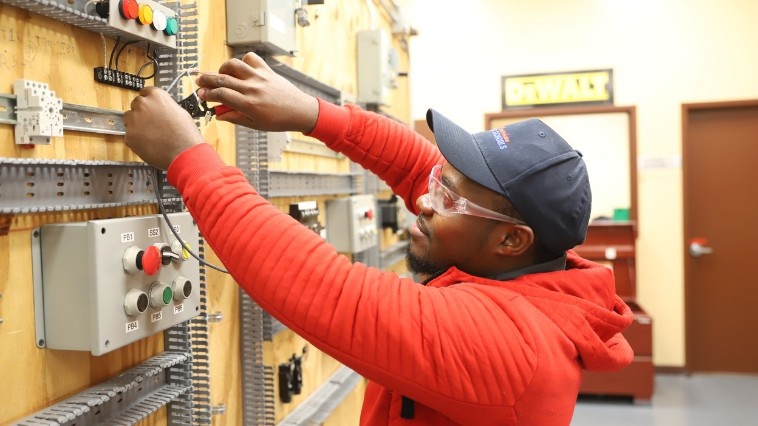
Most people think becoming an electrician means one thing: go to school, then get licensed. The real path splits in two, and both routes end at the same license and roughly the same number of required hours. In Maryland, that shared total comes to 8,000 hours of on-the-job training and 576 hours of classroom instruction, adding up to about four to five years, no matter which route someone takes.
Trade school does not replace that requirement. Instead, it prepares a student ahead of time. In some states, its classroom hours can count toward the apprenticeship’s classroom portion. Either way, an apprenticeship is required. The real question is how a person wants to spend the years leading up to it.
Key Takeaways
- An apprenticeship is required almost everywhere. Most states require between 4,000 and 8,000 hours of supervised work.
- Maryland requires 8,000 on-the-job hours plus 576 classroom hours. This rule has applied statewide since July 2022 under the Maryland Electricians Act (SB 762).
- Going straight into an apprenticeship, with no trade school first, usually means four to five years from day one to a license.
- Trade school trades a slower start for a head start. It builds skills before the apprenticeship even begins. In Maryland, a sponsor can also request credit toward on-the-job hours, classroom hours, or both. That credit is capped at 50 percent without special approval.
- Trade school does not shave hours off the on-the-job requirement. Its real value is making a stronger apprenticeship candidate.
The Two Paths, Explained
Trade school and an apprenticeship are two different things, even though people often talk about them as if they are the same step.
Trade school is classroom and lab time. It teaches the fundamentals before a student ever steps onto a job site as an apprentice. Finishing it does not make someone a licensed electrician, and it is not a substitute for the next stage. For a closer look at what these programs cover, see what trade school is.
An apprenticeship is a period of working under a licensed electrician, regulated by the state. Apprentices log supervised hours alongside classroom instruction, then test for a journeyman license. That step exists no matter what training came before it. There are no shortcuts.
Path 1: Skip Trade School and Go Straight Into an Apprenticeship
Some people can skip classroom preparation entirely and apply directly to a union or contractor. Accepted applicants start right away, earning entry-level wages while learning under a licensed electrician on job sites. In Baltimore, for example, the IBEW Local 24 apprenticeship runs five years. It requires 8,000 hours of paid on-the-job training alongside classroom coursework.
The tradeoff: openings depend on a contractor or union having room for a new trainee, so slots can be competitive and hard to time. Apprenticeships are more likely to be given to people who have graduated from trade school.
Path 2: Start With Trade School
Trade school flips that order. Students spend several months in classrooms and labs building fundamentals before ever applying for an apprenticeship.
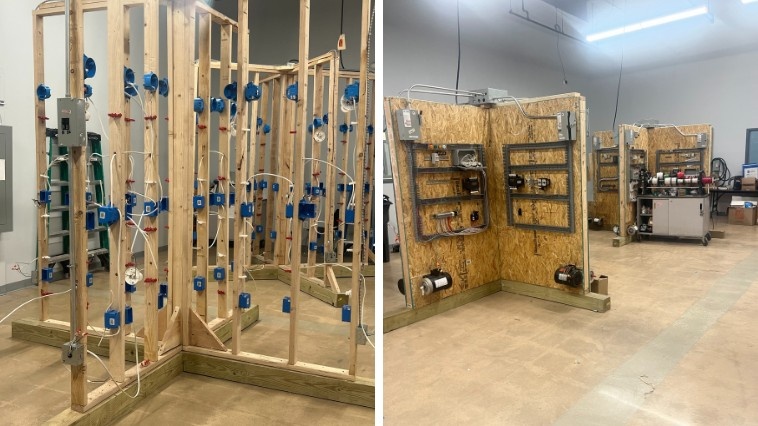
The Electrical Technology program at North American Trade Schools follows this model. It runs 39 weeks for daytime classes or 58 weeks for evening classes, covering residential and commercial wiring, machine control, programmable controllers, telecommunications wiring, and electronic control. Graduates leave within reach of NCCER Core and Electrical 1 Certification, plus OSHA 10, and are positioned for entry-level roles such as electrical technician, electrician helper, or low voltage technician.
None of that leads to a license on its own. Instead, it gives apprentices a head start. Students gain working knowledge of the trade before the apprenticeship clock starts running, build a stronger application, and skip the long wait for an open slot. These programs run on a set schedule instead of waiting for a contractor to have an opening.
Does Trade School Shorten the Apprenticeship?
Not the part that matters the most. Every state sets its own hour requirement, usually between 4,000 and 8,000 hours. An apprentice still has to log those hours under a licensed electrician. That holds true no matter what training came first.
The part that can shift is the classroom side. In Maryland, a state rule known as COMAR 09.12.43.05.L lets a sponsor request credit toward on-the-job hours, classroom hours, or both, based on an apprentice’s prior training. That credit is capped at 50 percent without special approval from the Maryland Apprenticeship and Training Council.
How much credit applies depends on the sponsor and the specific program. It is worth confirming directly with the school and the state board rather than assuming.
What Happens After the Apprenticeship?
Finishing the required hours opens the door to the journeyman exam. Pass it, and a person can work independently instead of under direct supervision.
Master electrician status sits one tier higher. In Maryland, reaching it takes seven years of qualifying experience. The Maryland State Board of Electricians allows up to three years of credit toward that total for approved schooling. Candidates also must pass a separate master exam. That final stretch takes roughly the same amount of time no matter which path a person took to get there.
Which Path Fits Which Student Best?
There is no single right answer here. It depends on what a student needs right now.
A direct apprenticeship tends to make sense for someone who:
- Already has a union or contractor connection lined up
- Is comfortable picking up fundamentals on the job rather than in a classroom first
Starting with trade school tends to fit better for someone who:
- Wants a foundation in the trade before applying for an apprenticeship
- Wants to strengthen their application when competing for limited apprenticeship openings
- May qualify for credit toward on-the-job hours, classroom hours, or both, depending on the sponsor and state
- Wants to start training on a set schedule instead of waiting for an apprenticeship opening
Choosing either path is a deliberate choice, not a backup plan. Both lead to the same license.
Getting Started
Whichever path fits better, trade school is where most people choose to begin. The Electrical Technology program at North American Trade Schools is built to be that first step. Students start on a set schedule, choose daytime or evening classes, and work toward NCCER Core and Electrical 1 Certification plus OSHA 10 before applying for an apprenticeship or an entry-level role.
Ready to move forward? Review financial aid options, look into veteran education benefits, and reach out through the Contact Us page today to talk to someone about enrolling!
Frequently Asked Questions
Do I need a high school diploma to start electrical trade school?
Yes. Most electrical technology programs require a high school diploma or its equivalent, such as a GED, to enroll.
Is there a minimum age limit for starting trade school or an apprenticeship?
Yes. Most trade schools and apprenticeships require applicants to be at least 18 years old.
Can an apprenticeship be completed faster than four to five years?
Rarely. The timeline is set by the total number of required hours, so it depends on how quickly an apprentice can log supervised work hours, not on effort alone.
Does prior military electrical experience count toward apprenticeship hours?
It can. Some states and apprenticeship sponsors give credit for verified military electrical training, but the amount varies and should be confirmed with the state licensing board.
What happens to apprenticeship hours if someone moves to a different state?
It depends on the state. Maryland has reciprocity agreements with Delaware, Virginia, West Virginia, and the District of Columbia, which can streamline the process for electricians moving into Maryland from one of those places. Moving to a state without a similar agreement may mean starting over under that state’s rules.
Can financial aid help cover the cost of electrical trade school?
Yes. Financial aid options are available for students who qualify, including support for veterans through education benefits programs.