

What if skipping the four-year degree wasn’t settling — it was strategy?
That’s essentially what Mike Rowe, the television host best known for Dirty Jobs and one of America’s loudest champions of skilled trades, told the audience at BlackRock’s 2026 Infrastructure Summit in March. During his remarks, Rowe described a recent visit to a data center in Plano, Texas, where he met three electricians — all under the age of 30, all debt-free — earning between $240,000 and $280,000 a year.
That alone would be a headline. But Rowe said the most striking part wasn’t the paychecks. It was the fact that all three of those young electricians had been poached three separate times in the previous 18 months.
“It’s like the draft in the major leagues,” Rowe told Fox Business.
Let that sink in. These weren’t seasoned veterans with 30 years on the job. They were workers barely out of their training programs, being recruited away by competing employers the way teams recruit elite athletes — aggressively, repeatedly, and at significant cost.
The Gap Between Perception and Reality
For decades, a cultural script told American students that learning a trade was a fallback — what Rowe himself called a “vocational consolation prize.” That script took hold in the 1970s and 80s, when school districts began removing shop classes and steering virtually every student toward a four-year college path. Parents were told it was the only reliable route to a good life.
The result? A generation of graduates carrying enormous debt into a job market that increasingly can’t absorb them all — and a skilled trades sector facing a critical labor shortage.
Student loan debt in the U.S. now exceeds $1.8 trillion. The average borrower carries more than $43,000 in student loan debt. Meanwhile, youth unemployment has crept back up, reaching 9.5% earlier this year. Plenty of college graduates are discovering that their degree doesn’t automatically translate into a job — let alone a career.
The trades, meanwhile, can’t find enough workers to keep up with demand.
AI Is Creating Jobs — for Skilled Workers
Here’s the twist many people miss: the rise of artificial intelligence isn’t hollowing out the skilled trades. It’s driving an explosion in demand for them.
Every AI system, every large language model, every data center running the tools you use every day — all of it runs on physical infrastructure. That infrastructure requires electricians to wire it, HVAC technicians to keep it from overheating, diesel mechanics to maintain the generators that keep it online when the grid goes down, and construction workers to build the facilities that house it all.
Jensen Huang, CEO of Nvidia, put it plainly in a recent blog post: “The labor required to support this buildout is enormous. AI factories need electricians, plumbers, pipefitters, steelworkers, network technicians, installers and operators.”
BlackRock’s Larry Fink, appearing alongside Rowe at the same Infrastructure Summit, agreed — and announced a $100 million investment in skilled trade training. Ford CEO Jim Farley has been even more blunt: “We are in trouble in our country. We have over a million openings in critical jobs — emergency services, trucking, factory workers, plumbers, electricians, and tradesmen.”
Research from Randstad USA confirms the trend, finding that the AI revolution is now “triggering a demand in skilled trades that is outpacing professional roles.” Robotics technician job vacancies have jumped by more than 113%. HVAC, welding, and general construction specialists are all seeing surging demand.
And for every 100 workers entering the trades today, 102 are exiting — many of them retiring. The gap is widening, not closing.
Gen Z Is Paying Attention
Something interesting is happening among the generation now entering the workforce: they’re doing the math, and the trades are looking better.
Six in ten Gen Z respondents in a recent survey by Resume Templates said they plan to pursue jobs in the skilled trades. Notably, about half of Gen Zers who already have a bachelor’s degree say they’re likely to pursue a trade in 2026. That’s not a backup plan. That’s a course correction.
It makes sense when you look at the numbers. A trade program — like the Electrical Technology, HVAC, or Diesel Technology programs here at North American Trade Schools — can often be completed in a fraction of the time and cost of a four-year degree. Apprentices in many trades earn wages while they train, meaning many graduates finish their programs with little to no debt. And the career waiting on the other side pays well from day one, with the kind of job security that no algorithm can automate away.
What the Electricians in Texas Already Know
The young electricians Mike Rowe met in Plano aren’t anomalies. They’re early movers in a labor market that’s shifting fast.
Data center electricians handle a far more complex scope of work than residential wiring — high-voltage systems, backup power infrastructure, cooling systems, and the redundancy setups that keep massive facilities running without a single interruption. The technical demands are real, and so are the rewards. Experienced workers in high-demand markets command premium compensation, and employers are offering overtime and signing incentives to compete for talent.
The U.S. is projected to need approximately 300,000 new electricians over the next decade, on top of replacing around 200,000 who are set to retire. That’s half a million positions in one trade alone.
Ready to Be a First-Round Pick?
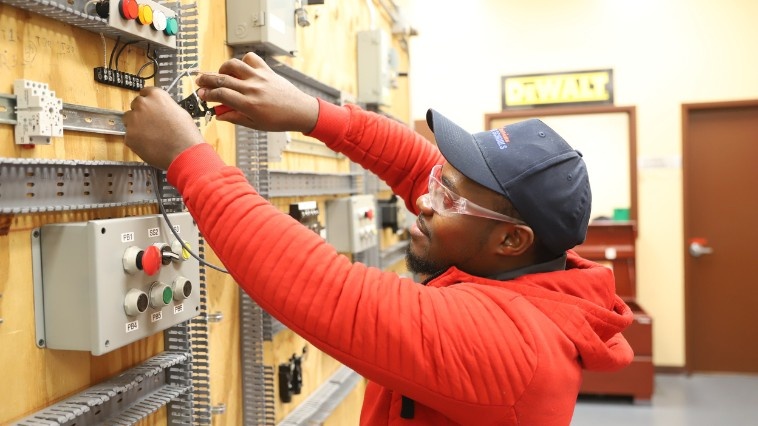
North American Trade Schools has been preparing skilled tradespeople in the Baltimore area since 1971. Our Electrical Technology program gives students the hands-on training they need to enter the field job-ready — the same foundation that’s launched careers like the ones Mike Rowe was talking about.
We also train students in HVAC, Diesel Technology, Combination Welding, Building Technology, and CDL Truck Driving — all fields experiencing surging demand.
The trades are no longer a consolation prize. For a growing number of smart, ambitious young people, they’re the prize.
Explore our programs and request more information →
Sources: Moneywise/Yahoo Finance, Fortune, Benzinga, Randstad USA, Federal Reserve Bank of St. Louis, Education Data Initiative, Resume Templates